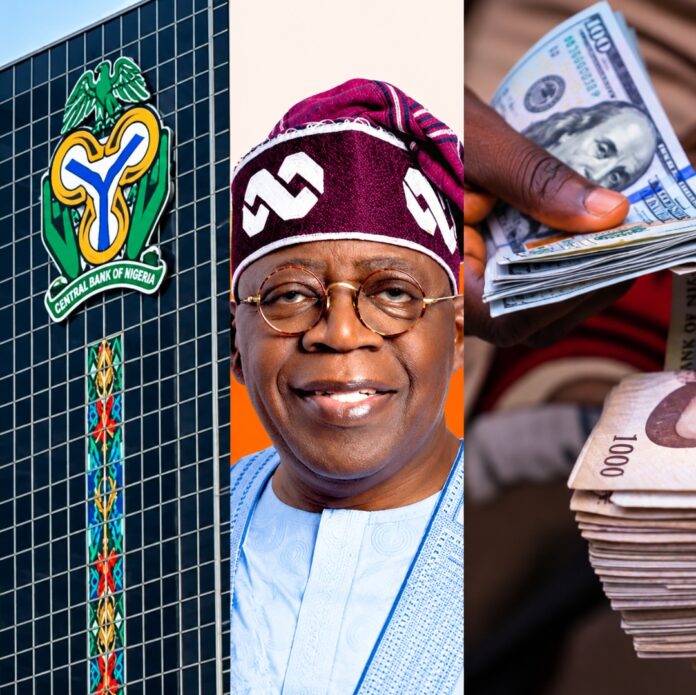
Nigeria’s foreign exchange reforms under President Bola Ahmed Tinubu have continued to generate debate, with critics highlighting the economic hardship associated with the depreciation of the naira. However, beyond the legitimate concerns about rising prices and the pressure on ordinary Nigerians, there is another side of the debate that deserves attention: the interests of individuals and powerful groups who benefited from the distortions in the country’s former foreign exchange system.
For years, Nigeria operated a multiple exchange rate system in which the official exchange rate differed significantly from the parallel market rate. While the arrangement was defended at different times as a way of managing foreign exchange demand and supporting economic activities, it also created opportunities for arbitrage, rent-seeking and the accumulation of wealth by individuals with privileged access to official dollars.
President Tinubu’s decision to reform this system was therefore not simply about changing the price of the dollar. It was also an attempt to address a structural problem that had encouraged unequal access to foreign exchange and created opportunities for some well-connected individuals to profit from the difference between official and parallel market rates.
The Lucrative Business Behind Multiple Exchange Rates
Under the administration of former President Muhammadu Buhari, Nigeria maintained different exchange rate windows, resulting in a substantial gap between the official and parallel market rates.
This arrangement created an obvious economic incentive for arbitrage. Individuals and businesses who could obtain dollars through certain official channels had the opportunity to sell them at significantly higher rates in the parallel market.
In a system where access to foreign exchange could be more valuable than the productive activities for which it was supposedly allocated, the potential for abuse was considerable.
The problem was not merely the existence of different exchange rates. It was the economic advantage enjoyed by those who could access foreign currency at preferential rates, while ordinary businesses and Nigerians without such connections had to contend with much more expensive dollars.
Such a system encouraged rent-seeking and weakened transparency. Rather than rewarding productivity, innovation and genuine economic activity, it created opportunities for people to make substantial profits from exchange rate differences.
Why Tinubu’s Foreign Exchange Reforms Matter
In June 2023, the Central Bank of Nigeria began implementing significant foreign exchange reforms, including the consolidation of exchange rate windows and a greater reliance on market forces in determining the value of the naira.
The objective was to reduce distortions, improve transparency, discourage speculative activities and create a more unified foreign exchange market.
The reforms also sought to eliminate the special advantages associated with accessing dollars at artificially favourable official rates.
Several respected Nigerian economists have expressed support for the principles behind exchange rate unification.
Professor Uche Uwaleke of Nasarawa State University has explained that exchange rate unification could reduce opportunities for speculation and arbitrage while promoting transparency and accountability in foreign exchange transactions.
Similarly, Dr Muda Yusuf, Chief Executive Officer of the Centre for the Promotion of Private Enterprise (CPPE), has argued that a more transparent and predictable foreign exchange market would be beneficial to Nigeria’s investment climate.
Gbolade Idakolo, Managing Director of SD&D Capital Management, is also among the financial experts who have discussed the importance of addressing distortions in the foreign exchange market.
The International Monetary Fund has likewise welcomed major foreign exchange reforms introduced by the Tinubu administration, including the unification of exchange rate windows.
These endorsements reflect an important economic argument: Nigeria cannot build a sustainable foreign exchange market around a system that rewards privileged access and encourages speculation.
Why Are Some Beneficiaries of the Old System Uncomfortable?
It is reasonable to question whether everyone criticising Tinubu’s foreign exchange policy is motivated solely by concern for ordinary Nigerians.
Certainly, many Nigerians have genuine reasons to complain. The depreciation of the naira has increased the cost of imported goods, raised production expenses, contributed to inflationary pressures and placed additional burdens on households and businesses.
Those concerns should never be dismissed.
However, it is equally important to recognise that economic reforms often threaten established interests, particularly where those interests depend on government-created distortions.
Under the previous system, access to official foreign exchange through certain allocations and channels could provide enormous financial advantages. There were also concerns about the abuse of some foreign exchange allocation channels, including travel-related allowances and foreign students’ allowances.
Where individuals benefited from questionable transactions, preferential access or the resale of officially sourced dollars at higher parallel market rates, a more transparent exchange rate system would naturally reduce those opportunities.
This raises an important question: Are all the loudest criticisms of the reforms genuinely about the welfare of Nigerians, or are some also driven by the loss of privileges that existed under the former system?
It would be unfair to suggest that every critic of Tinubu’s policy benefited from dollar arbitrage. Nevertheless, it would be equally naive to ignore the possibility that individuals who profited from the previous distortions may have personal reasons to oppose a system that limits such opportunities.
Criticising the Reforms Is Legitimate, but Selective Amnesia Is Not
There is no doubt that the implementation of Tinubu’s foreign exchange reforms has come with significant economic costs.
The sharp depreciation of the naira has affected purchasing power, increased the cost of imports and made life more difficult for millions of Nigerians. Government must take responsibility for addressing these consequences.
However, criticism of the current administration should not come with selective amnesia about the problems that existed before May 2023.
It is important to remember that a relatively lower official exchange rate under a multiple-rate system did not necessarily mean that dollars were readily available to ordinary Nigerians and businesses at that price.
A system in which a privileged few could access cheaper dollars while others paid significantly more in the parallel market was hardly an equitable arrangement.
The argument should therefore not be reduced to whether the dollar was cheaper under Buhari or more expensive under Tinubu. The more important question is whether Nigeria should maintain a foreign exchange system that creates opportunities for arbitrage and unequal access simply to preserve an artificially attractive official exchange rate.
Exchange Rate Unification Alone Is Not Enough
While the principles behind exchange rate unification are economically defensible, it is important to acknowledge that unification alone cannot solve Nigeria’s foreign exchange challenges.
The success of the policy depends on the country’s ability to attract foreign investment, increase non-oil exports, improve crude oil production, strengthen foreign exchange reserves and expand the supply of dollars into the economy.
Government must also implement policies that control inflation, support local production and reduce the cost of doing business.
A unified exchange rate should not become an excuse for ignoring the hardship Nigerians are experiencing. The administration must demonstrate that the sacrifices associated with the reforms are producing measurable improvements in economic stability and living conditions.
The Bigger Question Nigeria Must Answer
Nigeria’s economic problems cannot be solved by preserving every policy arrangement that existed in the past, particularly when some of those arrangements created opportunities for abuse and unproductive wealth accumulation.
A country cannot sustainably build its economy around a foreign exchange system in which access to government-allocated dollars becomes a source of extraordinary private profit.
President Tinubu should therefore be judged not simply by his decision to unify the foreign exchange market, but by how effectively his administration manages the consequences, increases dollar supply, restores confidence in the naira and improves the living conditions of Nigerians.
At the same time, politicians and public commentators must be honest about the economic failures of the previous system.
Those who genuinely care about Nigeria’s economy should be willing to criticise the shortcomings of the current reforms while acknowledging the need to dismantle the distortions that existed before.
Nigeria needs a foreign exchange system that rewards productivity, encourages investment and provides fair access to dollars, not one that turns privileged access into an avenue for enriching a few at the expense of the wider economy.